Category: Uncategorized

  • Blank(et) days

    Blank(et) days

    Writing about nothing says it all

    Scroll on for this month’s new book find, and a personal poem. Sometimes these messages are shortened by the email technology, so please consider clicking through to Substack and reading it in your browser. And while you’re there, why not leave a comment and a little love (heart)!


    Photograph in landscape of two dogs. One Collie dog is nose to the camera. A white patch around nose and between eyes. Second dog is also a Collie, black body, tan legs and white socks. Second dog is shaking itself so is blurred. Snow on the ground, with grass and fallen brown leaves. Original photo credit Tom Hodgkinson.
    Original photo by Tom Hodgkinson. “My Julbock” © 2023 Yvie Johnson

    Dear Kinfolk,

    As I write this, the last New Moon of 2023 is set to go lockstep with the sun, the Winter Solstice is ten days away, the Gregorian calendar will restart in under three weeks, and other festivities will be happening, for some of us, in between.

    For me, I’m fully committed to learning and exploring more about alternate cycles for understanding the year. There’s the astronomical calendar (perhaps the new year does begin at the Winter Solstice) and the astrological calendar (or it begins at the turning of Pisces into Aries at the point of the Spring Equinox). The Celtic Calendar (the Lunar variety) is one I simply love the look and feel of, being that it is thirteen months of lunar cycles and each month is named after a tree, and each tree is associated with rune symbols1. We’re currently at the Elder Moon stage, and the new year begins on 24th December (another new year version, on a very interesting date). This one feels earthy, very grounding. And then there’s the other Celtic Calendar which begins on 1st November with its welsh version being Calan Gaeaf (first day of Winter), also known as Samhain.


    In any case, the first of January only makes sense to the bureaucrat, not the poet.


    We have so many beginnings to choose from it’s not surprising we2 (in the West) picked the one in the middle but isn’t that a watered-down, wiped clean, synthetic beginning/ending? Where’s the symbology of the first of January?

    Tell me, why aren’t these calendar wisdoms of nature, skies, mythology, taught in schools whilst we are learning about the seasons and the names of the months? Why was my maths about Jack and Jane buying oranges and apples, but not about Diana and Hercules reaching across the night sky at particular times of year? Or that the Christian church co-opted the millenia of Pagan rituals that held relevance to the people who lived them. At some point we forgot that story telling was/is the best method for learning and retaining what we’ve learnt. The emotions that a story evokes helps it to en-root itself firmly in our minds. It’s not surprising that I remember nothing about the maths I was taught, but I do remember how I felt about learning maths3.

    Did I just distract myself with a mini-rant? Why, yes I did.

    It feels particularly poignant to note how we can hold both sadness and distrust alongside joy and serenity, at this time of year. We’re built that way, us humans, to simultaneously ponder a full range of emotions and feelings and thoughts. How we respond in a moment requires experience, wisdom and grace, to balance, understand and be aware of all these at once, before sending that reply, voicing that opinion, raising that objection.

    Christmas has always brought up sadness.

    Not melancholic, my natural state when my fizz state is dormant.

    Not nostalgic for days gone by (my distrust towards Christmas stems from too many traumatic Christmas-ness days over the first quarter of a century of my life, and I’m still working to clear that out).

    Not a mixture of Seasonal Affective Disorder mixed in with the lurgy.

    No, a genuine sadness. Christmas has never lived up to its message. Perhaps because the message was lost in its commercialisation, or its capitalist nihilism, and therefore the slow, wounding, peeling back of an ingrained cultural promise reveals that Christmas was taken over by Christianity and corporates4, and not for the wellbeing of culture or the benefit of promoting charitable characters.

    It’s perhaps also for this reason that I am searching for another purpose to bring cheer into this time of year— I think that returning to cultural history, re-infusing the ancient mythology and the archetypes of astrology back into this season will help me.


    And what am I listening to, to help me cope with all of these emotions and their polarities? A little bit of ommm…

    Spotify is playing an ensemble of instrumental tunes to help me think. It’s a lovely compilation/playlist to think to, I’ve called it Creative Soundscapes.


    I haven’t decided to not celebrate Christmas because other calendars appeal to me. Our traditions are only modest, but they’ve taken hold for our little family. It’s certainly telling when your middle child has asked for the celebrations to be repeated mid-January when then they are returning for a visit from their new base in Bremen, Germany. When it comes to other traditions, New Year Resolutions being front of mind, perhaps now is the better time to start thinking about them. As this last New Moon of 2023 fully embraces us I’ll be asking myself several questions: what am I calling in for the next six months; what does it mean to be me, at this stage of life; what does authenticity look and feel like; how can I show up more for myself and for others?

    To the Winter Solstice, to the new year of life that comes with the new light, I have hope and a glimmer of joy for what is still possible.

    Whether your new year resets in November, December, January or even on 10th February 2024 with the oncoming Year of the Wood Dragon for the Chinese and Lunar New Year, I wish you a year of abundant joys, of ease in releasing what you no longer need, to make way for the better to come in.

    Warmly,
    Yvie
    Landscape photograph with the text "Breath, be my nature" in lower right area. Snow-covered fields with a long winter hedge going through the centre. Hills in the background. Sun just about setting beyond the hills in the distance. Cloudless bright sky with blue at xenith and orange and yellow at the horizon. Original photo credit Tom Hodgkinson.
    Welsh sunset original photo by Tom Hodgkinson. “Breath, be my nature” edit © 2023 Yvie Johnson


    Book recommendation

    My reading is predominantly on Audible these days. It’s not my first preference, but I’m glad the option is there for me all the same. When there’s a book that I know I’ll be leafing through in random order, then it has to be a tangible entity (—even if its contents are intangible? Yes).

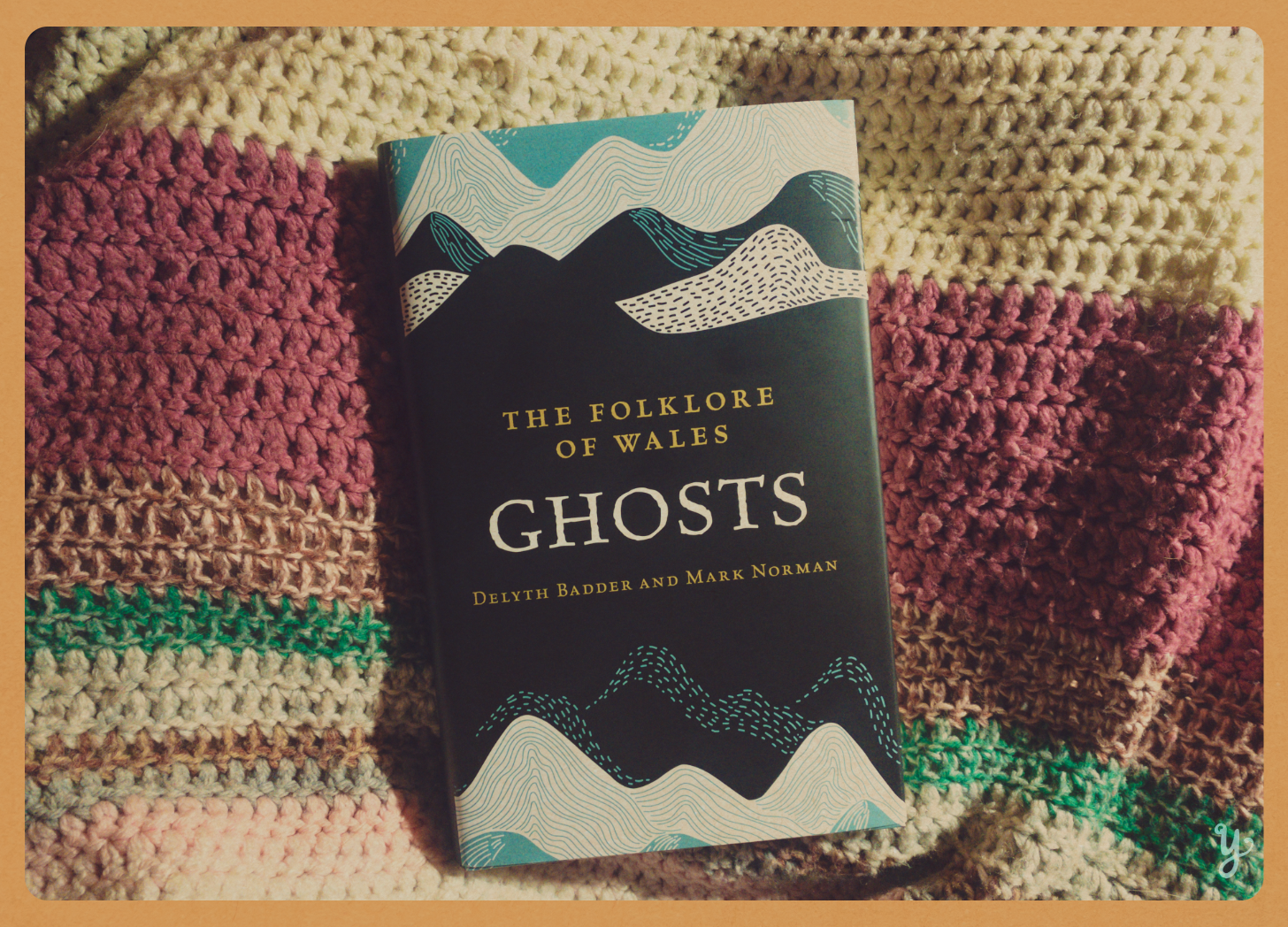
    This month, the hardbound, smartly-gotten, inscribed by one of the authors, book is The Folklore of Wales: Ghosts by Delyth Badder and Mark Norman. I spotted Mark on an Instagram post, sharing his new addition. Already a fan of his abundant podcast, The Folklore Podcast, I knew this would be a richly researched book and ordered it directly from his website. Here’s the publisher’s flap copy:

    Wales is a land with a vast wealth of ghost stories, including fantastical animals, flickering death omens and unseen things that go bump in the night. Whether these tales are based on true events, or are the creations of active imaginations, is known only to those who have experienced them — but what is certain is that their power to delight and scare us remains undimmed to this day.

    In The Folklore of Wales: Ghosts, renowned folklorists Delyth Badder and Mark Norman present an intriguing and comprehensive selection of ghostly accounts, illuminating key themes running through them, and giving insights into the history and culture of Wales’s varied regions and communities.

    With original Welsh texts, many translated into English for the first time, the authors present a wide panorama of stories and first-hand accounts that will be new to even the most seasoned folklore reader. Ranging from the distant past right up to the present day, this collection shines a spotlight on the unique qualities of folkloric ghost beliefs in Wales.

    Photograph of a book resting on a woollen blanket. The book is called "The Folklore of Wales: Ghosts" by Delyth Badder and Mark Norman.
    “The Folklore of Wales: Ghosts” by Delyth Badder and Mark Norman.

    Poetry corner

    As I head into my 7th year with M.E., this is a recent personal poem reflecting on more days with the illness, my bed, and a world that carries on without me.

    Blank(et) Days

    Yvie Johnson

    Empty, the sound my ears make when I’m listening for words to write. 
    Hollow drums, beating a rhythm against my temples, of doom at the doorstep of sense, and sensitivity to silence and all that jazz.
    Days flying by. Sun shining through my window, sweeping arc mostly missing me. Catching my jaw, chin up. These days happen, too.
    Give me an extra day. A few more hours. Mouthfuls of moments.
    A delivery missed, knock and run. Run slowly and knock twice. It’s all the same game.
    I can hear the bell.
    Hearing is heightened.
    Lights sway without the breeze. Loose from their dot of glue, it was never going to work. I can learn to hang loose, a deep breath, a long sigh. Shifting into another gear.
    Loosening.
    Letting go.
    Tightening. Tummy tithes, taken not given. Gurgling, lightning strikes, tension. 
    Waiting. Light dimming into the corner. I waited all day for the words to come. To make this make sense, to have something essential to say.
    I’ll try again tomorrow.

    © 2023 Yvie Johnson


    Have you read this yet?

    1

    Paterson, J. M. (1996) Tree Wisdom: The definitive guidebook to the myth, folklore and healing power of Trees. London: Thorsons.

    2

    We being the proverbial Emperor of Rome.

    3

    Bored. Frustrated. Stupid. Unintelligent.

    4

    MacLean, K. 2021 Christmas Before Christ: Yule & Other Northern European Traditions. Available at: https://youtu.be/Ra7b_IuS3Z8?si=E8Kv1Pv2USWTo1AU&t=1 (Accessed 21 December 2023)

    Leave a comment

  • The Season of Samhain

    On butternut squash, ice baths and Folktale Week

    Digital illustration by Yvie Johnson in wide rectangle with a bright purple border. The illustration is a section of a larger illustration. A Full Moon is rising behind pine trees, mist shrouds the pine trees, stars are scattered across the sky. The sky is a mixture of blues, pinks, and purples with specks of yellow. A distressed look. In the top right corner is the text which reads: The Season of Samhain in light colour on a striped paint of pinks and oranges.

    In the northern hemisphere, just by taking a look outside your window is enough to currently remind you that we are in a season that is preparing for its death.

    Goldier is a word

    That’s to say, the trees’ leaves are turning from green to gold to goldier and, if we’re lucky, that time for turning will be a variety of hues from pale ochre to amber to deep red. The ground is becoming a multi-layered blanket for children to bury into, for foliage to decorate, a mélange reminiscent of my attempts to bake a uniquely wonderful cake as a child, and for humans to contemplate whether there’s some discarded litter hiding. And find their hiding children. Or other things hidden, less desirable. Rarely, do we find treasure. At least, I haven’t ever found treasure kicking up leaves.

    My favourite part of the leaf colour-changing spectacle is finding the pinked-up purples and the blushingly bright reds that are as vibrant and deeply saturated as a slice of freshly cut beetroot or a basket of radishes. I recently learnt, somewhere, that the colours that eventually come out are related to the chemicals already existing within the leaf; this is the colour potential it always carries.

    Portrait full colour photograph taken by Yvie Johnson of a harvest of garden vegetables laid flat on a wooden crate. From left to right there are two and a half bright pink sweet potatoes. One pinky red rainbow beetroot with long stems and green leaves. One orange rainbow beetroot with long stems and green leaves.

    Personally, it’s my favourite time of year, in part because even if our flowers fail to bloom as readily as I’d hope, I’m always guaranteed an autumnal spectacle of colours. Also because my body simply prefers fresher air, sunlight without the weight of light on my eyes, and feeling as if I’ve not missed too much of the day if I get up not long after sunrise as opposed to missing sunrise by hours.

    Fruit as well as veggies

    This season is already bearing creative fruit for me. I gave my first professional online tutorial, live on the Zoom, no less, to an Adobe User Group based out of Florida. I’m now an Adobe Community Expert and I use Adobe Fresco and Adobe Express to make my illustrations and my social media content.1 Although, ironically, as I write this I am preparing to get into my first ice bath since 2017, and the thought of holding the juxtaposition of a hot climate of Florida and the impending ice bath in my mind at the same time is, as my son likes to say, discombobulating.

    This little ditty video above shows the illustration I created for the tutorial. It is a recreation of the Welsh folktale of Yr Hwch Ddu Gwta, the Black Tail-less Sow, in honour of Calan Gaeaf, meaning the first day of winter (in Welsh) which takes place on 1st November (incidentally the same day I gave my very professional zoom talk). Instead of carved pumpkins, here we have carved turnips and swedes, the Bwgan Rwdan (Turnip Ghouls).2

    Learning Welsh and Welsh traditions is not easy, but it is accessible thanks to books (in English) that share the stories and traditions with Welsh language applied where necessary. My favourite reference for this project was “Welsh Witchcraft” by Mhara Starling.

    Calan Gaeaf, and the evening prior being Nos Galen Gaeaf (Winter’s Eve), is specific to Wales and the northern hemisphere. I referenced this in my very first Substack offering which you can read here (or simply click on the spooky pumpkins below).


    Friends of Samhain

    Other iterations are known as Halloween followed by All Saints Day, or Samhain followed by Day of the Dead. The name this particular date in the calendar is referred to determines which culture or tradition one is more or less likely to be associated with, or know about. But I wonder how many Welsh families still know about the folklore of Nos Galan Gaeaf, or the ancestral honouring and feasts associated with Calan Gaeaf, more than, say, Halloween parties and trick or treating around the houses followed up with a sugar hangover and piles of sweet wrappers.

    What does it mean to honour one’s ancestors when historically ancestors may only have come up in conversation if a child dared/knew/remembered to ask, or someone in the family was a keen amateur genealogist. (I fit both of these categories but I certainly didn’t ask enough questions when my grandparents were still alive.)

    I first learned about Calan Gaeaf in 2022 as I was researching ideas for Folktale Week, the creative week on Instagram for just that —a week of folktales interpreted in our very own way through a series of images using prompts given by the founders and hosts.

    This is my favourite Instagram week of the year.

    I don’t get to be as fully involved as I’d like due to the quick turnaround needed; from the time the prompts are released, for fresh images matching the prompts to be ideated and conceived, and my preponderance for intricate, detailed, well-researched illustrations fitting something that I’m just learning on the fly. Also, I’ve only ever wanted to recount tales from the Mabinogion or of Welsh folktales from around the world. Researching both requires a good amount of time.

    Previous attempts of mine to contribute to the mass of wonderful, colourful and magical artwork for Folktale Week on Instagram can be found here, here and here. Also, here’s a little gallery of my folktale-inspired illustrations.

  • In anticipation of Calan Gaeaf

    And where we were before

    Gourdilocks and the Three-and-a-half Scares is a digital illustration for a book idea. On the left of the image is a cavernous doorway, a partially opened door with light streaming through onto Gourdilocks stood outside it. On the right of the page are three-and-a-half gnarly-looking pumpkins, surrounded by cobwebs and candlelight.

    Equinoxing to Wintering.

    This is a fresh start, and a refresh of my writing palette. A different place to create, to align with expressions that want to come from my soul, my heart, and even my mind. I can go on sometimes, but, really it’s very simple:

    1. Synchronicities are everywhere now

    I have a strong desire for lovely fonts outlining my words. This space lets me revel in just that, dreamily, joyfully. As I thought about why I love using this Substack space, the fonts called out to me. Then I looked at my clock and it read 12:34 so I took that as (another) synchronicity, the meaning being simply that I can do things for love. Even if that love is about letter shapes.

    2. No heroism required

    Can we enjoy each other? The expressions we make, the nuances and edges and the desires we have to be heard and represented. Be still if you need to, be gleeful, too. If I bring my soul to the party, on a platter of poetry, in a stocking of stories, will you bring yours?

    3. Vagueries may happen

    I’m not someone who speaks in enigmas, but I dare say my words don’t often be like, wut? Here’s the plan.

    • Free subscribers will receive two Cosmic Hiccups each month, Sundays be they may. What on earth is that?, I hear you ask. In fact, what in the cosmos, because, it’s in the title. A broad display of poetry (probably haiku but sometimes not), short stories that I hash out to see what sticks, and observational ramblings which may be more about philosophy, life as a disabled creative, melancholic wordlings, neurodivergent accoutrements. I will always add images because illustrating is my life force.

    • The Tale of Two Ends—now that tale is a whopper and requires lots of imagery and drafting and it’ll soon be only for paid subscribers (because it’s my life’s adventure). For now it’s also for free subscribers, until it won’t be.

    4. Here’s a post that I created earlier (elsewhere)

    I wanted to get this first Hello post out of the way, to clear the air, so that I can prepare you for what will be coming in terms of my writing. The next post will be Equinoxing, a serious post about my observations of my own evolving relationship with the word Disability and how I bring out my lived experience through creativity. Mine isn’t a unique story, and encapsulating all angles isn’t possible.

    I called the process of writing this Equinoxing (partly because I was writing at the time of the Autumn Equinox); a way of finding the balance between two presumably disparate aspects of life, creativity and disability. I hope you’ll come back so you can enjoy it.

    Digital illustration with text in front "Equinoxing" overlaying a drawing of two people reaching their hands out to each other. The person on the right is wearing a light t-shirt and dark dungarees. There are butterflies flying around with some on the clothing. The Disability Pride flag is shown on the front pocket of the dungarees.

    There’s more on the way!

    5. Thanks for reading and thanks for supporting!

    Right now I’m preparing for the coming of winter. I’ve a live Adobe Fresco presentation (I’m as nervous as you are) showing my art process from sketch to final piece ready to add to my shop (yes, I have an art print shop!). As an Adobe Community Expert I will be sharing more of my art process, in both video (hello introverted-me) and in words on here (and sometimes in other places too).

    This is occurring on the 1st November, a day in Wales known as Calan Gaeaf, which translates to the start of winter. Beginning the night before with the spooky Nos Calan Gaeaf, also known as Hallowe’en across the world, Calan Gaeaf is vaguely similar to Day of the Dead, perhaps mixed with a little All Saints’ Day.

    It’s a time for honouring ancestors, the end of the harvest, the start of the downtime.


    Thanks for reading As The Cosmos Hiccups! Subscribe for free to receive new posts and support my work.

  • PART 3: Shine a light on

    Who really has a seat at the table of our future?

    Voilà, the third and final illustration in this series created for Anna Maria Joseph’s article for Women Enabled International and Revival Disability India, and this time I added a little animation in Adobe Fresco to help make a spark.


    COP27 is underway.

    We’re still a world where certain groups decide who is allowed to have a voice based on how they look and present, as well as who is allowed to self-identify as disabled.
    Here’s a challenge, if the idea of self-identification feels misaligned: come from a place of compassion for yourself first, and then compassion for the other.

    I say this without malice or blame, it’s not easy to accept someone else’s perception of themselves if you are not yourself comfortable with who you are, who you believe deserves help and support, who deserves credit, and who deserves to be reckoned with.

    Illustration: A person wearing a coral orange top with stripes of blue inverted triangles in a mandala-esque design and jeans, blue belt and blue shoes, sits on a stool with their eyes closed, and head raised hopefully looking towards the light. They have purple hair that flows down their shoulders, with a yellow barrette on one side, pinned above their right ear. There is a hearing aid in this ear. In one hand, they are holding onto a blue leash that’s tied around a dog with black and white fur, wearing an orange coat with a white medical cross on the front. Their other hand is holding down a pull chain that lights up a yellow spotlight above them. A bulb that is attached to an orange bulb holder is visible. The background is in dark blue with twinkling stars shown in light blue-green. There is imagery of sunflowers in three places in the illustration—four sunflowers growing from the ground beside the stool that they are sitting on, one on the left side of the top they are wearing, and one as a brown line illustration on their left forearm.

    I am disabled, I admit it took time (years) to adjust, in order to begin to accept, but I’ve managed to come to this peace within myself because of the light of others shining bright and strong.

    Being disabled is not less, and does not mean less deserving.

    Being disabled is not voiceless, if anything it is a powerful voice that illuminates within each of us the parts that need to be held with greater compassion.

    Do you have the strength of compassion to help shine a light on Disabled Climate Activism?

    Read Anna’s article to understand more about the intersection of disability and climate activism here.


    Thank you for reading As The Cosmos Hiccups. This post is public so feel free to share it.

    Share


    Be sure to check out…


    Part 2: In the liminal

    Also be sure to check out the finished full article over here.

  • PART 2: In the liminal

    We really don’t all float down here

    This is the second illustration created for the collaborative article “Cripping Climate Activism” between Women Enabled International and Revival Disability India by Anna Maria Joseph, with interviews by Àine, Lakshay and Tej.

    Illustration: a person with purple hair in their room, advocating from their bed, on their laptop. They have their headphones on and are wearing a yellow shirt. A portion of their room is visible. A visual on an orange background shows a close-up of their laptop screen, which presents a blog with the title, ‘MAPA’.

    When Anna asked me to create an illustration, I knew outright there was too much to illustrate in one piece. Here the aim is to show the positive synergy and negative outcomes of activism that are probably overlooked.

    The question of how can disabled folk become involved in the climate agenda is illustrated, but potentially isn’t recognised. Activism is too often considered the active part of disruption, but activism comes in many forms, and can reinforce itself.

    Illustration: On a purple background with pink twinkling stars, there are 4 visuals. One is on a yellow background in the shape of a speech bubble which features a person with purple hair in their room, advocating from their bed, on their laptop. They have their headphones on and are wearing a yellow shirt. A portion of their room is visible and includes a blue bedside table with medicines on it and a red first aid box, a stand above their bed with books and plants, and another bedside table on the opposite side of the bed in green color, on which their walking stick rests. A visual on an orange background shows a close-up of their laptop screen, which presents a blog with the title, ‘MAPA’. There is another visual on a green background, again in the shape of a speech bubble which features two people attending a climate protest. One person is standing holding a yellow board with black text, “most to lose” in all caps, and the symbol of a wheelchair user. They are with another person who is in a purple color wheelchair. Their faces are blurred out in black color. There is a hand in the foreground holding a video camera that is recording the two protesters and the tag on the top of the camera reads D.W.P in all caps. There is a final visual featured on a greyish-blue speech bubble. It shows a climate activist speaking at the UN. They have their blonde hair braided and are wearing a purple top and blue jeans, fastened with an orange belt. There is a graph behind them that shows how the climate crisis is escalating.

    Here is a disabled, bed-bound activist (hello!) writing on their laptop sharing information in a blog, which may lead to paid work. Getting access to accurate and useful information is part of the whole narrative of climate justice because this culture war is not just about beliefs, it’s also about words.

    This person’s article can be used as research at a climate conference. Research can just as easily be delivered by a disabled person with visible or invisible disabilities, as by someone who has no concept of that world.

    The supporting protest marches that occur at the times of conferences can involve disabled protestors with their carers. However, it has been found that disabled protesters are likely to be recorded and their information sent to the DWP who in turn can decide to no longer offer disability benefits.1

    Not only do disabled people, who form part of the MAPA (Most Affected People and Areas) group, have to face the brunt of decisions taken on their behalf by uninterested parties, they can also lose possibly their only source of income for highlighting the precocious and collusive nature of business-as-usual

    How can you help?

    Support your disabled activists.
    Reinforce the inclusive agendas of all climate justice programmes.

    Remember that if the basic level doesn’t include the needs of all disabled folk, then it’s not basic, it’s exclusionary.


    Thank you for reading As The Cosmos Hiccups. This post is public so feel free to share it.

    Share


    Continue to Part 3: Shine a Light On

    To read the full article by Anna please click here.

  • PART 1: Access is just the start

    More than ramps are needed where we’re all going

    This series of illustrations forms work created for a commission in collaboration between Women Enabled International and Revival Disability India discussing real climate justice from the lens of disabled activists, Àine, Lakshay and Tejaswi.

    Digital illustration of a person with burgundy-coloured hair, wearing a green top and blue pants is sitting in a wheelchair, holding a white colour board with blue text that says, “Nothing about us, without us” in all caps. There are symbols for a wheelchair user and a hearing aid on it. The person is facing a closed door that is greyish blue in colour and has twinkling stars in light blue coming up from a large keyhole. The door has a pale-yellow sign hung on it that says “climate forum” in all caps, with text yellow in colour. The wall around the door has bricks that are orange in colour, followed by pastel green, yellow and brown colours. There is a blanket of green leaves that hangs from the top of the wall. A blue pot with an orange flowering plant sits beside the door and has a note in yellow with the text, “gone 4 lunch” in black and all caps. The ground is grey in colour. The person in the wheelchair looks dejected at not being able to attend the climate forum.

    Grateful to Anna Maria Joseph (Instagram) for reaching out to me with such a powerful article as a backdrop to create some fresh illustrations on this very important subject.

    To read Anna’s full piece with illustrations please visit here.


    I pulled from personal experience to create this piece.

    I don’t get out much, in my wheelchair when I do, usually it’s to visit a hospital or my GP where access is plenty; except for the car park where folks still think parking on the ramp access to a pavement is fine because it’s some form of space.

    It’s not fine to be wheeled into oncoming traffic on a blind bend.

    Part of the reason I don’t get out more is because I already know how poor wheelchair access is in my town, and most towns around me.
    Any and all planning for a future with adjustments for climate has to also be fully accessible for any wheelchair or any person needing accommodations.

    When basic needs begin with disability needs being addressed first, everyone benefits in the span of their lifetime.

    Digital illustration of a person with burgundy-coloured hair, wearing a green top and blue pants is sitting in a wheelchair, holding a white colour board with blue text that says, “Nothing about us, without us” in all caps. There are symbols for a wheelchair user and a hearing aid on it. The person is facing a closed door that is greyish blue in colour and has twinkling stars in light blue coming up from a large keyhole. The door has a pale-yellow sign hung on it that says “climate forum” in all caps, with text yellow in colour. The wall around the door has bricks that are orange in colour, followed by pastel green, yellow and brown colours. There is a blanket of green leaves that hangs from the top of the wall. A blue pot with an orange flowering plant sits beside the door and has a note in yellow with the text, “gone 4 lunch” in black and all caps. The ground is grey in colour. The person in the wheelchair looks dejected at not being able to attend the climate forum.

    “Cripping Climate Activism” is the title of the full article. The concept of crip time is that things simply take longer when you have to navigate an able-designed world. The “Gone 4 Lunch” sign is indicative of not taking into account how it’s not always possible for disabled activists to access the same event in a reasonable time.

    How can this be addressed?


    Thank you for reading As The Cosmos Hiccups. This post is public so feel free to share it.

    Share


    Continue to Part 2: In the Liminal

    To read Anna’s full piece with the full set of illustrations please visit here.

  • The pain cave

    And drawing.

    She slowly emerged from her pain cave.
    To draw.
    
    Finding meaning 
    in pain,
    part of my grief process.
    Making meaning.
    Seeking the joy 
    in the meaning.
    Holding the tranquility
    in the pain.
    
    (Most days are trying to hold back feeling as if I have a rotten fever, and trying to express this in words is easier than drawing it, but if I could draw what this process looks like, this is where I'd start. 
    Slowly emerging from a pain cave, just to draw.)
    
    It feels like a huge ask, really. 
    This new
    (three years in still feels new) 
    version of living.
    
    No mountain climbing, 
    no quick running 
    up 
    to the castle, 
    no long trail walks with dog, 
    no telephone calls, 
    home movie nights, 
    cooking, 
    baking 
    or shopping.
    
    Just a little 
            reaching out 
    to the space in front of me. 
    
    Hoping the daylight 
    isn't too much
    and
    I can keep my eyes
    open.
    
    Can I hold someone's hand.
    Can I eat by myself.
    Can I breathe in some fresh air from the doorstep.
    
    Incremental gains, 
    the one percents, 
    are all I aim for. All I ask for. 
    
    Drawing is the biggest aim, it used to be something I took for granted. 
    
    Now, if I can get a sketch in, 
    I've won this battle.
  • Then

    A link between time and space

    Beaming dusts of gold
    Shining bright at t'edge of time
    Where our then meets now
    Landscape photograph of a view from hillside overlooking the sun setting on the horizon and a valley in between. Sun beams are very bright displaying streaks of light across the landscape. Some clouds in the sky. A peaceful setting.

    As The Cosmos Hiccups is a reader-supported publication. To receive new posts and support my work, consider becoming a free or paid subscriber.

  • Folktale Week 2020

    Illustrations from probably oldest collection of stories from the British Isles

  • Hoo you looking at

    The owl makes a comeback.

    Look hoo is back

    Dancing around the May Pole is for Folktale Week day 7 and “Dance”.

    So this dance doesn’t exactly happen in the Mabinogion, however, the backstory of the beautiful otherworldly Blodeuwedd (see also day 5, the death of Gronw Pebr) who was magically created out of flowers to be the wife of Lleu, is also the story of the Flower Bride, alternatively, the May Queen.

    In brief, in the Mabinogion, Blodeuwedd falls in love with Gronw, tragedy ensues, and the magicians turn her into an owl so that she may never again show her face in the light of day.

    She was the beauty in the light of day, she is now the dark night at odds with other birds.

    This flower maiden is created as the perfect wife to serve her man, but she empowers herself by falling in love with another man. She must mature and gain wisdom through taking responsibility for her actions.

    The dance of the May Queen occurs at Beltane, where she weaves a ribbon around a pole, a symbol of fertility and the spiralling nature of life.1

    This Mabinogion story also tells us that beauty is only skin-deep.

    Deep stuff.